Keep your fingers crossed for some clear skies
The annual Draconid meteor shower is set to peak tonight (October 8) in the UK, meaning Brits could be treated to some amazing views in the night sky.
The meteors will be visible until October 10, but it’s on Tuesday evening that the shower will peak.
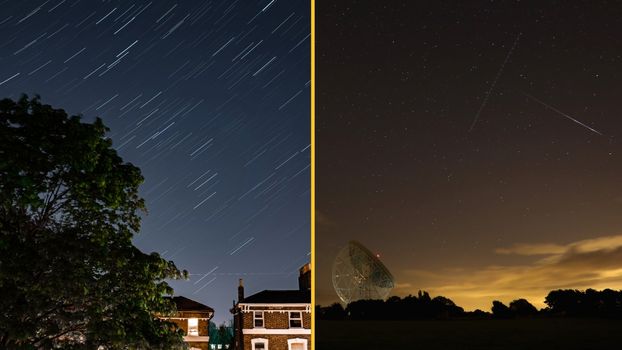
Meteors appear as streaks of light in the sky, and are often referred to as shooting stars.
The Draconid shower gets its name from the Draco constellation and the meteors come from the debris leftover from Comet 21 P/Giacobini-Zinner which is currently on a trajectory past Earth.
When the Earth passes through this debris, which is usually made of rock or ice, it burns up in the atmosphere, creating streaks of light in the sky.
The Draconids are known for their unpredictability, and has been known to produce a stellar 1,000 meteors per hour in the past.
So, what are your chances of spotting them in the sky, and how can you increase your chances?
What are weather conditions meant to be like tonight?
Well, there’s good news and bad news. The BBC reports that UK skies will be reasonably dark tonight thanks to a first quarter moon which will set early on in the evening.
But, of course, this is all pretty useless if those pesky clouds are in the way, and there could be plenty of tonight.
Low pressure to the west of Ireland will be sinking southwards, causing showers and rain across parts of the UK. The clearest skies will be in parts of south-west England, south Wales and possibly north-west Scotland.
Because of the weather, it may be that tomorrow (Wednesday October 9) actually provides a better chance of seeing the meteors, despite this not being the peak of the shower.
Conditions on Wednesday are meant to be clearer after sunset across the far south of the UK and north-west of Scotland.
How can you watch the Draconids?
If you’re lucky enough to be blessed with clear skies, the Draconids will be best viewers in the evening by looking to the north.
The good news is you shouldn’t need a telescope or binoculars to see the shower.
If you can get to a dark area away from any city lights and light pollution, just look to the night sky, give your eyes about 15 minutes to adjust to the dark, and then you should be able to see the meteors with the naked eye.
Don’t worry if you do miss them though, as another meteor shower, called the Orionids, is set to peak on October 21 and 22.