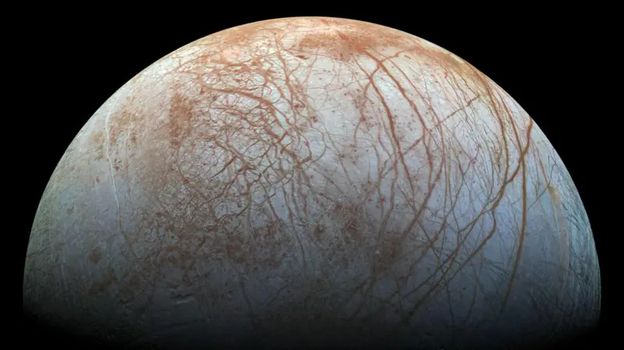
It will embark on a 1.8 billion mile journey
NASA have launched a spaceship in search of alien life on a far-flung moon in the depths of our Solar System.
The spacecraft known as Europa Clipper was launched today at 12:06 local time (16:06 GMT) after Hurricane Milton forced the mission to be postponed by a week.
The small probe has now began a journey of 1.8 billion miles to reach a strange moon orbiting Jupiter known as Europa.
Europa is an icy moon, known for its vast ocean under its surface with double the amount of water on Earth which scientists hope could hold indicators of life.
Unfortunately, for those keen alien hunters among us, the spacecraft won’t arrive at its far away destination until 2030, so people will have to be patient to see what Europa Clipper uncovers.
This is not actually the first time a spaceship has been launched with the intention of reaching one of Jupiter’s moons, with a European Space Agency mission leaving last year.
However, the ESA are on a mission to visit another one of Jupiter’s moons, Ganeymede.
Despite this, thanks to a cheeky cosmic piggyback, NASA’s craft will arrive first at Jupiter.
The craft had to be rushed back indoors last week with the arrival of Hurricane Milton, but now has been able to launch in search of new life.
Speaking to the BBC, Mark Fox-Powell, a planetary microbiologist at the Open University said: “If we discover life so far away from the Sun, it would imply a separate origin of life to the Earth.
“That is hugely significant, because if that happens twice in our solar system, it could mean life is really common.”
The icy moon has a crust that is up to 25km thick, with potentially a vast saltwater ocean hiding below as well as possible chemicals that are the base ingredients for simple life.
Scientists hope the spacecraft can map almost all the moon while also collect dust particles and fly through plumes of water.
The spaceship houses a laser that will be able to see through the thick ice crust.
Europa Clipper will orbit both Earth and Mars to gain a gravitational assist that will provide a slingshot effect to help it reach Jupiter faster and is the largest craft ever built to visit another planet.