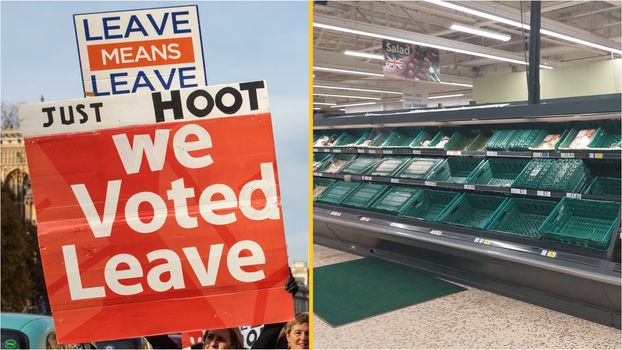
Poor weather in Europe has been cited as the main reason for fruit and veg shortages in supermarkets
The former CEO of Sainsbury’s has said UK supermarkets have been “hurt horribly by Brexit” as they struggle with fruit and vegetable supply shortages.
On Tuesday, Asda and Morrisons imposed purchase limits on lines of fruit and vegetables, with other supermarkets considering similar temporary measures.
Asda has introduced a customer limit of three on tomatoes, peppers, cucumbers, lettuce, salad bags, broccoli, cauliflower and raspberries.
Morrisons said it would be introducing limits of two items per customer across tomatoes, cucumbers, lettuce, and peppers from Wednesday (February 22).
Same in Sainsburys nr Preston. Took the photo to prove to my husband I hadn’t just forgotten to get tomatoes & then my Twitter feed is bombarded with empty shelves. #brexitsucks pic.twitter.com/z3nuZ2UxCX
— Martha (@garthamallacher) February 19, 2023
The main reason given for the supply shortages has been poor weather and below-average temperatures in countries such as Spain and Morocco, which the UK relies on for its winter supply of some fruit and vegetables.
But as shoppers here shared photos of bare shelves, European supermarkets shelves were apparently heaving with produce.
Britain's fruit & veg shortage is due to an 'extreme weather event' affecting the whole of Europe, according to the boss of Waitrose. This is nonsense. Brussels on a Monday before they finish stacking the shelves. pic.twitter.com/qBTjPkItrL
— Frédéric Moreau 🚎 (@goodclimate) February 20, 2023
Seeing lots of photos of empty fruit & veg shelves in UK supermarkets with claims that it's the same all over Europe, blaming everything except Br*x*t.
So, this morning's selection in local market, shop and supermarket here in Catalonia (EU). pic.twitter.com/YXCyBpYTZ6— Brian Cutts (@brian_ebre) February 21, 2023
M&S Director Justin King has said it is impossible to ignore the impact that Brexit has had on the supermarket industry.
He told LBC that UK greenhouses, previously known to grow tomatoes, have suffered in recent years.
“These are products that we do produce, or in the past have produced year round in the UK,” Mr King said.
He continued: “North Kent, in Thanet, [had] the largest greenhouses in Europe, which used to be full of peppers, cucumbers and tomatoes.
“But those greenhouses have suffered, really, from two big things. I hate to say it, Nick, but it’s a sector that’s been hurt horribly by Brexit.”
He added that the supermarket industry had also suffered from the government’s decision to exclude it from its energy support scheme, and that “without support on energy, it’s not been economically viable to produce under glass during the winter this year in the UK.”
'I'm not sure anybody can really argue that three cucumbers is somehow depriving them of their weekend salad.'
Ex-CEO of Sainsbury's Justin King tells @NickFerrariLBC that the 'terrible' weather in main producing countries is what's caused 'massive' food shortages in the UK. pic.twitter.com/CecfoWzR81
— LBC (@LBC) February 22, 2023
Producers have been cutting back on greenhouse numbers due to soaring energy prices over the winter.
Addressing the purchase limits on some fruit and veg, an Asda spokesperson said: “Like other supermarkets, we are experiencing sourcing challenges on some products that are grown in southern Spain and North Africa.
“We have introduced a temporary limit of three of each product on a very small number of fruit and vegetable lines, so customers can pick up the products they are looking for.”
King said that fair purchase policies such as this are the “right way to manage in the short term” and should help supermarkets to resolve the issue in a “small number of days.”
Supplies of fruit and veg from Europe and Africa have been disrupted because bad weather, such as below average temperatures and flooding, over the winter has led to a poor harvest.
Growers and suppliers in Morocco have had to contend with cold temperatures, heavy rain, flooding and cancelled ferries over the past month, affecting the volume of fruit reaching Britain.
And supplies from Spain have also been badly affected by bad weather.
Production problems in Morocco began in January with unusually cold night-time temperatures that affected tomato ripening.
It is hoped that the shortages will ease in the coming weeks as British producers move into the growing season. This is expected to ease long-term pressures on retailers looking for alternatives to items produced in Spain and north Africa.
Related links:
- Prime fans who queued overnight for Sainsbury’s stock disappointed after being met with empty shelves
- Piers Morgan says it’s ‘time to admit Brexit has been a disaster’ and calls for second referendum
- Brexiteers are making millions out of the demise of the British economy