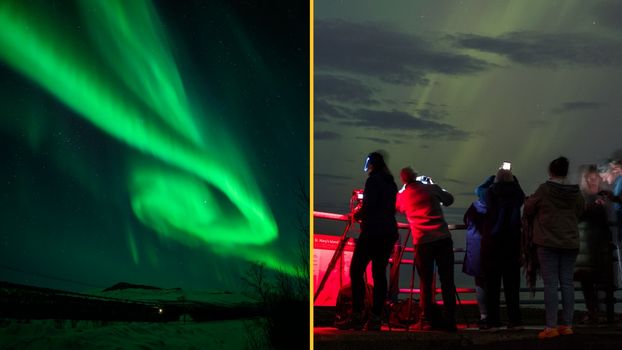
What a year for the aurora!
The Northern Lights are set to once again light up UK skies tonight with the Met Office informing of the chance to see the lightshow.
This year has seen on onslaught of solar flares and coronal mass ejections that have paraded our skies in places not often treated to the illuminating spectacle.
Notably, in May this year, the aurora could be seen across the entire UK and as far south as central Europe.
Now, after a large solar flare on Thursday, the aurora borealis is expected to be back visible in the UK from Saturday evening with a large area of the UK potential bearing witness to the dancing lights.
The Met Office said: “Saturday night has the greatest likelihood of aurora sightings further south, across central England.”
One of the most incredible spectacles the natural world has to offer, the aurora borealis, commonly known as the Northern Lights, occur when electrically-charged particles are given off by solar storms and eventually collide with the earth’s atmosphere.
Speaking to The Guardian, Silvia Dalla, a professor of solar physics at the University of Central Lancashire, said: “To maximise your chances of viewing the aurora, the sky needs to be as clear as possible. Look northwards and try to find a place with dark skies, ideally away from a city where light pollution can interfere with the view.”
Related links:
Increased solar flare activity causes coronal mass ejections (CMEs), sending out electrically charged particles from the sun which become trapped in by the Earth’s magnetic field.
Once trapped, the particles then heat up atoms in the Earth’s atmosphere by smashing into them, resulting in the bright colours we know as the Northern Lights.
The aurora are usually visible from countries closest to the Arctic, such as Canada, Iceland and Norway.
But when there is particularly large amount of solar activity, they can be visible further south than usual – such as from northern parts of the UK.
For best viewing of the aurora borealis, you’ll need clear, dark skies relying on a lack of moonlight as well as minimal cloud clover.
If you’re still struggling to get a clear sight of the lights, advice follows that a phone camera can help locate them as they detect the colourful display more effectively than the human eye.